


It's September 15, 2007, at Rice-Eccles Stadium. No. 11 UCLA is playing the unranked 0-2 Utes. On key third downs, the MUSS—the Mighty Utah Student Section—erupts with so much noise that the Bruins can’t hear their own signals. They jump early. They jump again. By the final whistle, the Utes have demolished the Bruins 44–6. UCLA coach Karl Dorrell would later admit, “We just didn’t handle the noise very well. We lost our poise and had some critical penalties that stalled some drives.”
In the almost 25 years since its founding, the MUSS has built a reputation for earsplitting sound and ground-shaking energy—so much so that in 2023, U geoscientists installed a seismometer at the stadium to measure what they dubbed “UteQuakes.” The fans’ zeal has also earned recognition: In 2021, ESPN and Taco Bell named the MUSS the Live Más Student Section of the Year.
For Kai Cruz, 2026 MUSS president, it’s about more than making noise. “I’ll get into my seat and turn around and see thousands of students all ready to go,” he says. “There’s nothing that fires me up more than that—the sense that you’re part of something bigger than yourself.”
How It Started
Twenty-five years ago, Utah wasn’t known for football. Ticket sales at Rice-Eccles languished. As for the student section, “There was just dust rolling through it,” former Utah Athletic Director Chris Hill said in a 20th-anniversary video about the MUSS.
Utah was considered a basketball school. The Rick Majerus era had Runnin’ Utes fans flocking to the arena, energizing the team’s NCAA Tournament runs. A student section called the Huntsman Center Hooligans supercharged the arena’s electric atmosphere and made every home game a spectacle.
Utah Football wanted in on that magic. Kim Sorrentino, then assistant marketing director of Utah Athletics, and John Fackler, then a director of alumni relations, proposed a football fan club, which would be managed by the U Alumni office, and enlisted nine students to help build it.

“The students would literally accost people and say, ‘Hey, you need to go to football games,’ ” says Fackler BS’89 BS’94 MprA’95.
Thanks to those efforts, and the students’ suggestions to improve ticketing policies, the club sailed past its initial goal of 300 members. Then came the shot of adrenaline Utah Football needed—a fiery young coach named Urban Meyer, who launched Utah Football into a successful new era that Kyle Whittingham would carry forward.
Every year, as Utah Football’s star rose, the MUSS matched pace, recruiting exponentially more students and obtaining thousands more seats at Rice-Eccles.
How It’s Going
Nearly 25 years on, game day at Rice-Eccles runs rituals the MUSS made its own. Almost none of them were planned. Most started the same way: a student with an idea, and a section willing to try it.
Third Down Jump

This tradition—making eardrum-shattering noise to prevent the opposing team from converting on third downs—first appeared at a 2006 BYU–Utah game, led by future 2008–09 MUSS president Philip Malugade BS’09 and Kyle Larson HBS’09. “We worked with John Fackler, who saw the potential for this to take off,” Malugade recalled in a 2021 Utah Magazine article.
It was officially adopted at the 2007 UCLA game and became the MUSS’s trademark.
“Coach Whittingham would tell us, ‘You are the 12th man on defense during the Third Down Jump,’ ” says Avery Abelhouzen BA’22, 2021 MUSS president. “It really felt like we had this distinct role of potentially forcing the other team to have a false start.”
Moment of Loudness
It starts like a usual moment of silence—everyone up, phone flashlights on. Then it changes course. Instead of quiet, there’s thundering, heart-pounding noise.

When Utah Football set out to honor the memory of Ty Jordan, a running back who died tragically in December 2020, they wanted the gesture to feel personal. Jordan’s freshman season was during the COVID pandemic, explains Abelhouzen, and he passed away without getting to experience the roar of a capacity Rice-Eccles crowd. The Moment of Loudness was a way to give that back to him.
“The football team and Coach Whittingham came to us and told us how much they wanted the MUSS to be a part of it,” she says. “Everyone felt how powerful it could become.”
When cornerback Aaron Lowe was killed less than a year later, the Moment of Loudness embraced him too. Both had worn 22, and Utah retired the number that season. Now the roar goes up for Ty, Aaron, and all loved ones the U community has lost.
The MUSS Bus
The tradition of chartering a bus for one road game a year started in 2003 at Coach Urban Meyer’s suggestion, after the Utes made it to the Liberty Bowl.
Jake Olson BA’05 helped organize that first trip, a nonstop 28-hour ride from Salt Lake City to Memphis, Tennessee. Olson recalls watching copious movies on the bus’s VHS players, eating barbecue on Beale Street, going to Graceland and the National Civil Rights Museum, and hearing Utah’s and Southern Miss’s bands duke it out, battle-of-the-bands style, at a bowl-game lunch.
 Then, before the game, the director of football operations approached the MUSS. There’d been a mix-up, and they needed a few ball boys. Olson volunteered. “I was on the sidelines for the game with the players,” he says.
After a 17–0 Utes victory, the inaugural MUSS Bus trip left for its 28-hour leg home—five people shy.
“They couldn’t stomach the ride back,” Olson remarks.
More Muss Moves
U OF U CHOP
An early MUSS tradition. The band plays a specific rhythm, and students flash the U while “chopping” to the beat.
FLAG FOOTBALL

Urban Meyer suggested a yearly game between MUSS members at Rice-Eccles. The first prizes: Crown Burger (winners) and unfrosted Pop-Tarts (losers).
FALSE START TALLY
When an opposing lineman flinches, the MUSS hangs a number 5 over the railing—one for every five yards the penalty gives back.
LIGHTING THE 'U'
After a win, the football team stands in front of the MUSS and presses a lever to light the U on the mountain.
HIGH FIVES

After games at Rice-Eccles and the Huntsman Center, Utah players high-five the lucky students in the MUSS's first row.
FIRST DOWN CHANT
For every Utah first down, MUSS members raise their hands, yell “first down!,” and point downfield, mimicking the ref.
RUNNING THE FLAGS

Raffle winners at MUSS tailgates get to run the MUSS flags onto the field as the team enters the stadium.
The entire trip was a great time, he says, but spending a total of 56 hours on a bus was more akin to a trauma bonding experience.
“To this day, I’ll see some of [those original MUSS Bus riders] at a Utah game, and we don’t really have to say anything. We just look at each other and nod.”
Where It’s Headed
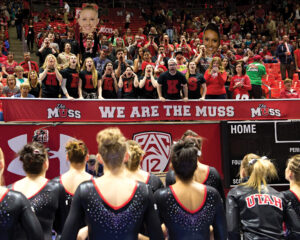
As it nears 25 years, the MUSS has helped transform Rice-Eccles into what commentators have called “one of the great environments in college football” and “the most underrated home-field advantage in the country.” MUSS Board members want that magic to touch all sports.
“It’s our goal to rebuild what was once an amazing basketball culture here on campus,” says Cruz, the 2026 MUSS president. A new committee will put more focus on both men’s basketball and women’s basketball games. And a new rewards system for attending non-football events has already boosted student turnout in almost every U sport.
“It makes a big difference to our athletes when fellow students cheer them on in the stands,” says MUSS Board member Molly Sarto, part of the Olympic sports committee. Her favorite event? Red Rocks meets. “The gymnastics team is unreal,” she says. “We were able to go observe a practice one time, and I was like, ‘I’m standing inches away from Olympians.’ ”
3-POINT JUMP

A spinoff of the Third Down Jump. Students make noise after every Utah 3-pointer to disrupt the opponent’s possession.
STICK IT

When a gymnast sticks a landing, the MUSS sticks a note with her name on a sign that says “Stick’d.”
SOCCER DRUMS

Borrowing from global soccer culture, the MUSS drumline thunders with beats every time Utah scores a goal.
U'S UP

Before every Utah free throw, the band claps and yells “throw up your U!” and the MUSS follows suit.
A MUSS Love Story

It was love at first sound when Michael Holzrichter BS’18 met his future wife, Shannel Holzrichter (née Kruse) BS’18.
Michael was sitting in the MUSS, watching Utah fail to convert a first down again and again, when he heard a female voice a few rows back yelling, “Why are we running the same play again?”
“I was like, one, thank you for saying that, and two, who are you? I need to meet you,” says Michael.
They spent their second date camping out for ESPN’s College GameDay, where Michael “knew it was love again” when Shannel showed up to Presidents Circle with tacos. When Michael became MUSS president and Shannel got a job with Utah Football, they saw even more of each other. Five years (and countless games and MUSS Bus trips) later, they were married. Now they have a baby girl, Mariah, who will attend her first Utes game this fall.
Comments
Comments are moderated, so there may be a slight delay. Those that are off-topic or deemed inappropriate may not be posted. Your email address will not be published. Required fields are marked with an asterisk (*).